Eat the Frog vs Eisenhower Matrix: Which Should You Use?
Eat the frog vs the Eisenhower Matrix, plus Ivy Lee and the 1-3-5 rule: what each method decides, where each one fails, and how to combine them in a week.
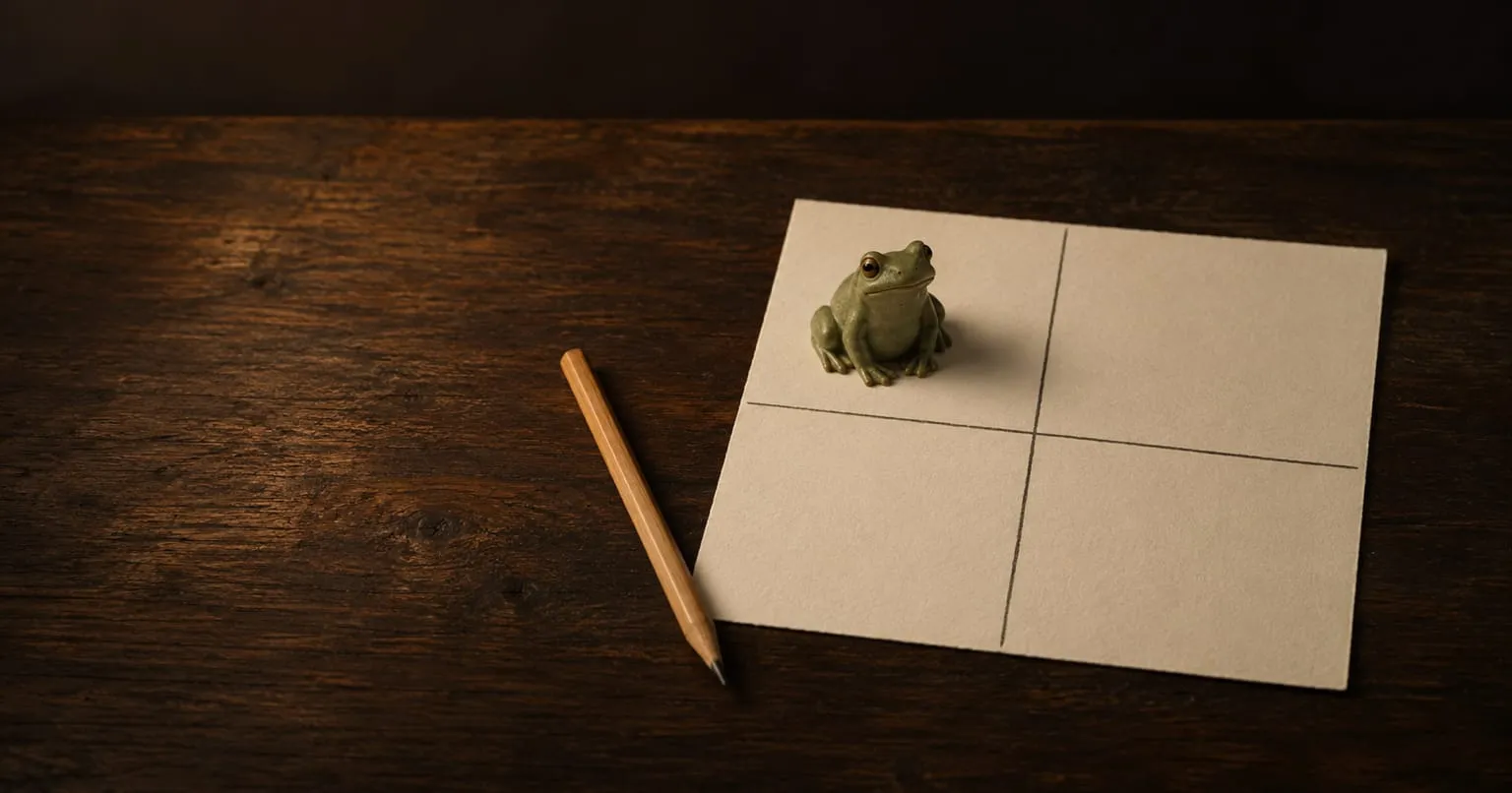
Eat the frog and the Eisenhower Matrix answer different questions, so you rarely have to choose between them. The Eisenhower Matrix sorts a whole list by urgency and importance and tells you what to do, plan, hand off or drop. Eat the frog picks one task and tells you when to do it: first. Use the matrix about once a week to clean up the list, and use the frog every day to decide what gets your first hour.
What is the Eisenhower Matrix?
It is a grid of four boxes. One axis asks whether a task is urgent, the other whether it is important, and each box has its own instruction.
| Urgent | Not urgent | |
|---|---|---|
| Important | Do it now | Plan when you will do it |
| Not important | Hand it off or batch it | Drop it |
The name comes from a 1954 speech by Dwight D. Eisenhower, who quoted a former college president: “I have two kinds of problems, the urgent and the important. The urgent are not important, and the important are never urgent.” There is no sign Eisenhower drew the grid himself. The four-box version became popular through Stephen Covey’s 1989 book The 7 Habits of Highly Effective People, which calls it the time management matrix.
What is eat the frog?
Each day you pick the one task that matters most and that you are most likely to avoid, and you do it before anything else. Brian Tracy made the idea popular with his 2001 book Eat That Frog. We covered how to choose a frog, plan it the night before and slice a big one in eat the frog: how to do your hardest task first.
How are they different?
| Eisenhower Matrix | Eat the frog | |
|---|---|---|
| Question it answers | Which tasks deserve my time at all? | What do I do first today? |
| Works on | The whole list | One task |
| Time frame | A week or a project | One day |
| Best when | The list is overflowing, or full of other people’s requests | One important task keeps getting postponed |
| Weak spot | Says nothing about order or how to start | Ignores the rest of the list |
The matrix has two more weak spots worth knowing. “Urgent” inflates easily: every message with a red dot feels urgent while you are looking at it. And “hand it off” assumes someone to hand it to, which most students and solo freelancers do not have. For them, that box usually means “do it later, in one batch”.
Why urgent tasks win by default
Both methods exist to fight the same pull. In a set of experiments published in 2018, Meng Zhu, Yang Yang and Christopher Hsee found that people chose tasks with a short deadline over tasks that paid more but had no time pressure, even when the deadline meant nothing. They called it the mere urgency effect. A ticking clock makes a small task feel important.
That is why the important work that is not due yet keeps sliding. Nothing about it shouts.
Where does the frog sit in the matrix?
Almost always in the important but not urgent box, the one the matrix tells you to plan. That box is where good plans go to wait. You schedule the task for Thursday, Thursday fills up with urgent things, and the task moves to next week.
Eat the frog is a rule for that one box. It does not just say “plan it”, it says when: the first block of tomorrow, before your inbox. Tasks in the urgent and important box do not need a rule like this, because their deadline already makes you act.
There is one exception. When something truly urgent and important lands, such as a production outage or a deadline moved to today, it becomes the frog by default. Deal with it, then give the real frog the next block you can protect.
Ivy Lee and the 1-3-5 rule
Two other methods often come up in the same searches, and both sit close to the frog.
The Ivy Lee method comes from a story usually dated to 1918, in which the consultant Ivy Lee advised Charles Schwab of Bethlehem Steel. Each evening you write the six most important tasks for tomorrow and number them by importance. The next day you work through them in order and move anything unfinished to the next list. It is eat the frog with a queue behind the frog.
The 1-3-5 rule, popularised by the career site The Muse, caps each day at one big task, three medium ones and five small ones. It limits the list by size rather than by importance. The “one big task” is a natural place for your frog, and the cap stops the rest of the day from pretending it can hold more.
| Method | What it decides | Use it when |
|---|---|---|
| Eisenhower Matrix | What to keep, plan, hand off or drop | The list has grown past what you can do |
| Eat the frog | The one task that goes first | One important task keeps getting avoided |
| Ivy Lee | The order of tomorrow’s six tasks | You want a short, fixed queue for the day |
| 1-3-5 rule | How much one day can hold | Your days are full of small obligations |
How to combine them in one week
- Once a week, about 15 minutes. Write down everything on your mind and sort it into the four boxes. Drop what belongs in the “not urgent, not important” box. Group the urgent but unimportant tasks into one batch you will clear in a single block, for example after lunch. Copy the important but not urgent tasks onto a short list. Those are next week’s frog candidates.
- Each evening, about 5 minutes. Pick tomorrow’s frog from that short list and write its first step, small enough to start in ten minutes.
- Each morning. Frog first. Then the urgent tasks, then the batch.
The matrix keeps the list honest and the frog makes sure the list’s most important item actually happens. Neither one alone does both.
Which method should you choose?
- If you have too much to do, start with the matrix. Cutting tasks helps more than ordering them.
- If you keep avoiding one thing, start with the frog. You do not need to sort a whole list to fix one postponed task.
- If your day is a stream of other people’s requests, use the matrix for the stream and protect one block for a frog, even if it is not the first hour.
- If you are a student with one big deadline, use the frog every day and slice the deadline into daily steps.
How we handle this in Rana
Rana is the daily half of this system, on purpose. It does not sort your whole list. Each morning it asks one question: what’s today’s frog? You can keep up to three tasks, but only one is the frog, and it always comes first. If the frog is too big to start, you can slice it into up to ten small steps, and the first only needs ten minutes. For the weekly sort, use paper or the task manager you already have, then bring one task a day into Rana.
Try it this week: on Sunday, draw the four boxes on a sheet of paper, and on Monday morning eat one frog from the important but not urgent box.
Questions people ask
Who invented the Eisenhower Matrix?
The idea comes from a 1954 speech in which Dwight D. Eisenhower quoted a former college president on urgent and important problems. The four-box grid came later and was made popular by Stephen Covey's 1989 book The 7 Habits of Highly Effective People.
Can you use eat the frog and the Eisenhower Matrix together?
Yes, and they fit well. Use the matrix once a week to clean up your list and find the important work that is not urgent, then pick one of those tasks each evening as tomorrow's frog.
Which quadrant of the Eisenhower Matrix is the frog in?
Usually the important but not urgent quadrant. Urgent tasks get done because the deadline forces them; the frog is the important task that nothing forces, which is why it needs a rule.
What is the Ivy Lee method?
Each evening you write down the six most important tasks for tomorrow, in order of importance. The next day you work through them in that order, and anything unfinished moves to the next list.